
Exploring, Testing and Learning Together on Superintendent’s Conference Day
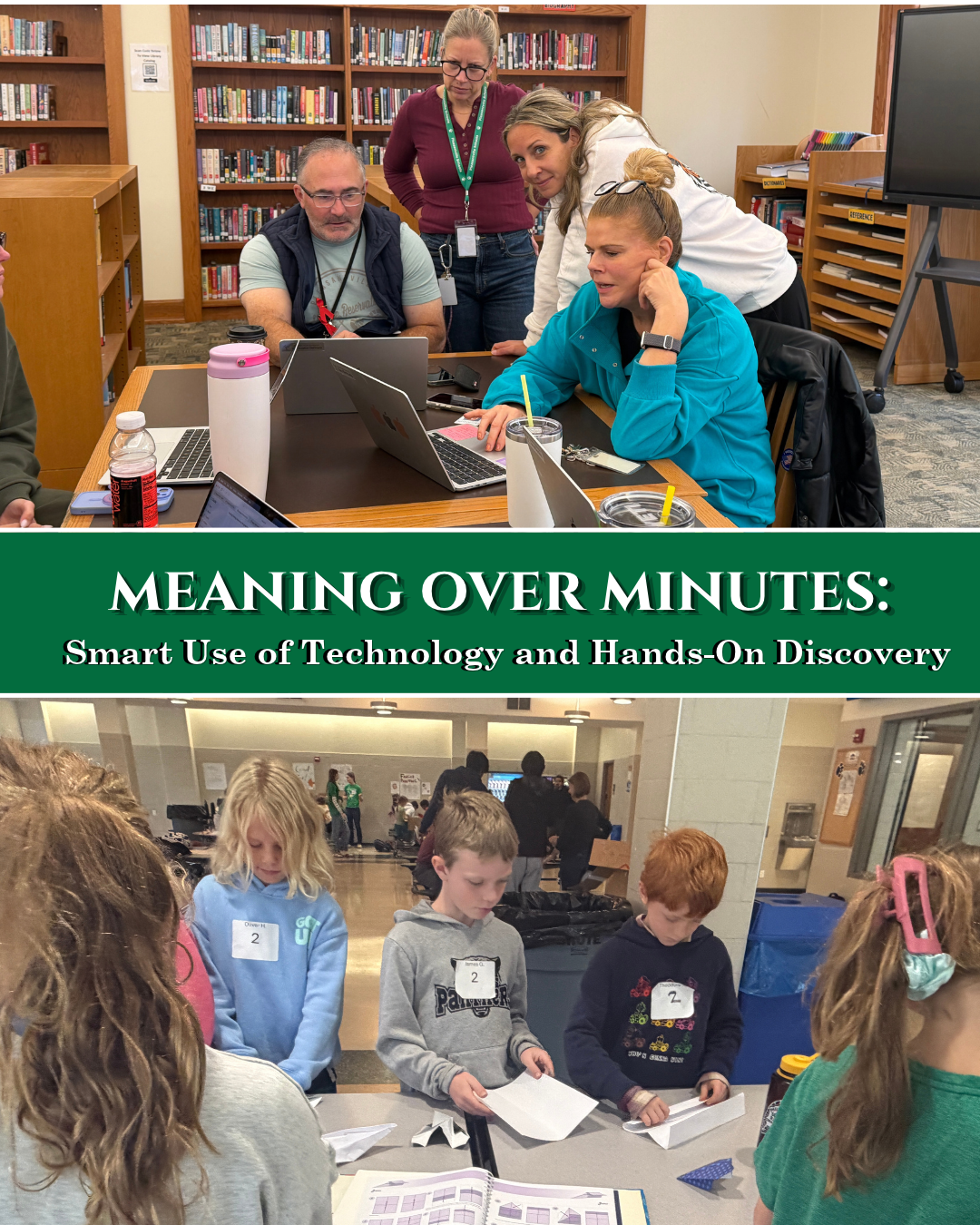
From delving into the instructional possibilities of artificial intelligence to building bridges, launching projectiles and experimenting with scientific concepts, our November 3rd Superintendent’s Conference Day was all about finding new ways to inspire learning.
Faculty and staff spent the morning examining how AI can be used thoughtfully and effectively to enhance teaching and learning. At the same time, approximately 30 younger students participated in a hands-on STEM experience led by members of the Pleasantville High School and Middle School Science Olympiad teams. Together, the activities reflected a shared emphasis on curiosity, critical thinking, problem-solving and the value of learning through exploration.
Exploring AI as a Tool for Teaching and Learning
A significant portion of the day’s professional learning focused on two complementary goals: equipping teachers with strategies to help students understand and use AI safely and responsibly, and exploring how AI can serve as a professional support to teachers, helping to enrich lessons, personalize learning experiences and foster critical thinking.
Through hands-on demonstrations and practical examples, faculty explored ways to use AI to adapt instructional materials to meet students’ diverse learning needs. Pleasantville Middle School English teacher Tara Birrittella used AI while preparing a lesson on The Outsiders to develop customized resources for English as a New Language (ENL) students, making the text and its themes more accessible while maintaining meaningful academic expectations. Seated next to her, math teacher Chris DeGrazia was doing the same in his own subject. Because AI can quickly align lesson ideas with New York State standards, the two spent less time on that groundwork and more time trading ideas about creative new ways to present material and teach key skills.
“AI has given me the ability to tailor lessons to the needs of individual students in ways that would have taken hours to do on my own,” said Ms. Birrittella. “It also enables me to explore creative new ways to present ideas, which helps me engage students and bring the material to life for every learner in the room.”
That kind of exchange happened throughout the day. Nearly all of the sessions were led by Pleasantville’s own educators and combined facilitated discussion with peer-to-peer learning, rather than leaving teachers to work alone at their computers. As educators discovered useful approaches, they shared them with colleagues, sparking conversations that led others to try new prompts, adapt ideas for their own subjects and build on one another’s discoveries. In that way, AI became a catalyst not only for new instructional ideas, but for collaboration and creativity among teachers.
Another area of focus was using AI to develop more sophisticated questions for classroom discussions, quizzes and assessments. Teachers explored how the technology can help generate questions that reflect and are modeled on the types of higher-order thinking increasingly emphasized on New York State assessments and Advanced Placement (AP) exams. Rather than simply asking students to recall information, these questions challenge them to analyze, interpret, apply knowledge and support their reasoning.
Throughout the sessions, the emphasis was on using AI with purpose. That means using it not as a substitute for teachers’ professional expertise, but as a resource that can expand instructional possibilities, support differentiated learning and create more opportunities for students to engage deeply with academic content.
“Our goal is to empower teachers to use AI safely, creatively and intentionally in ways that improve the learning experience for students,” said Director of Technology Michael Sammartano. “Just as important, when teachers model AI as a tool that supports critical thinking rather than replaces it, students learn to use it the same way: to ask better questions, test their ideas and think more deeply.”
Dr. Joshua Deitch, Director of Curriculum, Instruction and Assessment, echoed that idea. “As educators, we’re not just teaching students about which tools exist,” he said. “We’re teaching them how to challenge the tools and their findings.”
Young Scientists Put Their Ingenuity to the Test
Just one floor below, in the cafeteria, innovation was taking a decidedly hands-on form as younger students participated in the STEM Mini Camp. The camp was created four years ago by high school students, including now-senior Prerna Gupta, and serves as the PHS Science Olympiad team’s annual fundraiser. It is supported by members of the Pleasantville Friends of STEM, a nonprofit that supports the district’s Science Olympiad teams and the PHS science research program.
Working alongside older students who served as mentors and guides, the young learners rotated through seven interactive stations that challenged them to design, build, test and refine their creations.
At one station, students constructed bridges and tested how much weight their designs could support. At another, they built catapults, experimenting with construction techniques and launch angles to see how successfully they could propel objects through the air.
Students also got an up-close look at devices that Science Olympiad members build for competition. In one demonstration, a device used air pressure to launch a ping-pong ball, with a laser helping guide its aim as team members adjusted the trajectory to land the ball in a bucket.
Not every bridge held, and not every launch hit its target, but each attempt was a chance to adjust and try again. The Science Olympiad mentors kept students thinking at every step, asking them to predict what would happen before each test and then reflect on what actually did. They affirmed students’ guesses and followed up by asking them to explain their reasoning, striking a balance between challenge and encouragement. Students were just as comfortable sharing ideas with one another, and the room was full of support. As one participant explained, help was always available, but figuring things out on their own was part of the fun.
Along the way, students built confidence, persistence and collaboration, and discovered that learning can be just as meaningful when an experiment doesn’t go as planned.
Different Approaches, Shared Goals
The professional learning sessions and STEM Mini Camp looked very different, but both centered on helping students engage more deeply in their learning. For teachers, that meant exploring together how AI can strengthen teacher practice, helping educators personalize and deepen instruction for every student. For younger students, it meant testing their own ideas, learning from what didn’t work and trying again.
Together, they offered a glimpse of how innovation takes many forms in Pleasantville, from embracing new technologies to giving students room to discover what they can accomplish through their own ingenuity.