
Beyond Agreeing to Disagree: English Students Build Critical Thinking Skills Through Debate
Does suffering build character?
It's a complicated question without an easy answer, and one that 10th-grade English students were challenged to explore through a structured classroom debate inspired by Maya Angelou's memoir, I Know Why the Caged Bird Sings.
The assignment asked students to do more than develop an opinion. They needed to build a persuasive argument grounded in evidence from the text, anticipate opposing viewpoints, and engage respectfully with classmates whose interpretations might differ from their own.
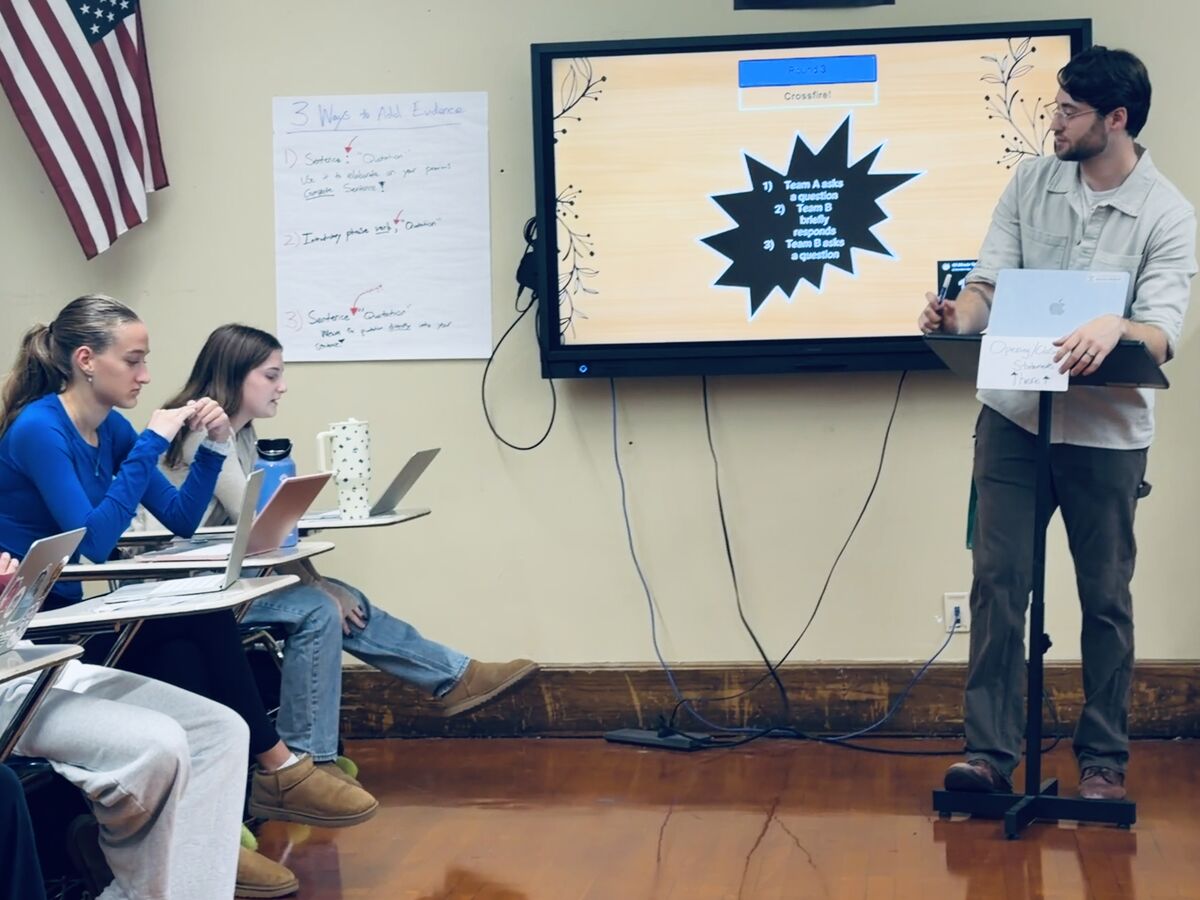
In Gianmarco Martignetti's and Kaitlyn Zapletal's English class English class, co-taught with Kaitlyn Zapletal, students were divided into two teams, one arguing that suffering builds character and the other taking the opposing position. Working collaboratively, they developed their arguments, identified specific passages and quotations from Angelou's memoir to support their positions, and prepared questions to challenge the opposing team.
Students received explicit direction on how to strengthen their arguments with evidence. They were expected to return to the book, identify quotations that supported their positions and clearly indicate when they were quoting the text. The characters and their experiences served as the proof behind their claims, reinforcing the distinction between expressing an opinion and building an argument grounded in literature.
The arguments reflected different interpretations of Angelou's experiences. Students arguing that suffering builds character emphasized how lived experiences can shape a person's ability to understand and relate to others who have endured similar hardships, including exposure to violence. Without having experienced those circumstances firsthand, they argued, it can be difficult to fully understand what someone else has endured.
The opposing team argued that the suffering Angelou experienced had a more negative impact on her than any character development that may have resulted. In their view, the potential benefits of building character did not outweigh the harm caused by those experiences.
"Debate isn't about proving who was right; it's about being persuasive and making the point," Mr. Martignetti said.
Learning How to Disagree
While the debate centered on Angelou's experiences and the larger question of whether suffering builds character, an equally important lesson was unfolding: how to engage in meaningful dialogue when people disagree.
Students followed clearly established expectations for respectful discourse. When addressing a classmate, they were expected to use the student's name, make eye contact, listen carefully, and respond thoughtfully rather than dismissing an opposing viewpoint.
A reference sheet displayed on every desk reinforced four essential discussion strategies: Challenge, Clarify, Confirm and Extend. Students were encouraged to question an argument respectfully, seek a better understanding of another person's reasoning, acknowledge points of agreement, and build on ideas by introducing additional evidence or perspectives.
Students also practiced the language and conventions of formal discussion. When introducing something they wanted to ask the opposing team, they were directed to begin with the word "Question," signaling clearly that they were seeking a response rather than presenting another argument.
The format also introduced students to the structure and accountability of formal debate. As one team posed questions, members of the opposing team listened and recorded their thoughts, preparing responses and identifying points they wanted to challenge. Not every argument could be addressed immediately. Students sometimes had to hold onto their ideas until Crossfire, the final portion of the debate, when teams had an opportunity to question and respond to one another more directly.
Although students collaborated in preparing their positions, they also needed to think independently and respond in the moment. Points were awarded throughout the exercise, with the two teams finishing with closely matched scores of approximately 36 out of a possible 40.
For students, the debate format offered an engaging way to explore the text while learning from one another.
"I like learning this way because you have to listen to the other side and really think about what they're saying," said Julianna Zaino.
"It helps you understand the book better because you're looking at it from different perspectives," added Mackenzie Campanaro.
Creating Space for Difficult Conversations
The subject matter made the expectations for respectful discussion particularly important.
Angelou's memoir explores racism, poverty, violence, sexual abuse and other deeply personal experiences. Examining these themes requires students to consider difficult realities while recognizing that their classmates bring different backgrounds, perspectives and life experiences into the classroom.
Ms. Zapletal emphasizes that establishing a culture of trust is essential to helping students engage meaningfully with sensitive material.
"Before we can dive into difficult or sensitive topics, we have to build a community where students feel safe enough to be vulnerable," she said. "As teachers, we know trust is co-created with students by setting clear boundaries, listening without judgment, and honoring every voice in the room. When students know their dignity is protected, they stop worrying about being 'wrong' and start engaging meaningfully with the material."
One exchange illustrated how a seemingly straightforward question can become more complex when students take time to consider different perspectives.
As the discussion turned to poverty and the potential dangers of living in an impoverished community, students acknowledged the privilege of growing up in a relatively safe community like Pleasantville. Some suggested that people living in poorer areas of the county, where they perceived crime to be more prevalent, would naturally want to move to a community like theirs if given the opportunity.
But other students challenged that assumption. What if someone had lived in a neighborhood for generations, surrounded by family, friends and a strong sense of community? Would leaving behind those relationships and the place they called home really be such an easy decision?
The exchange broadened the discussion beyond questions of safety and economic opportunity to include belonging, identity and the emotional ties people have to their communities. What initially appeared to be a straightforward choice became considerably more complicated as students listened to one another and considered circumstances different from their own.
It was an example of what the exercise was designed to accomplish: encouraging students to look beyond their initial assumptions, consider perspectives they might not have recognized, and understand that complex questions rarely have simple answers.
Building Skills That Extend Beyond the Classroom
The approach is not limited to 10th grade. Mr. Martignetti’s freshman students are engaging in similar discussions through their study of I Am Malala, the memoir by Malala Yousafzai, which explores her experiences growing up under Taliban rule in Pakistan and her advocacy for girls' education.
Their debate centers on another thought-provoking question: Is it inspiring or irresponsible to allow young people to be the face of movements?
The question challenges students to consider both the power and potential risks of youth activism. Like Angelou's memoir, I Am Malala explores difficult themes that invite different perspectives. Mr. Martignetti believes even ninth graders have the maturity and skills to engage thoughtfully with these issues in a respectful, supportive classroom environment.
Across both grade levels, the lessons extend well beyond literary analysis. Students are learning to construct evidence-based arguments, communicate clearly, listen actively and respond to ideas that challenge their own thinking. They are also developing the ability to disagree without becoming disrespectful and to recognize the value of perspectives different from their own.
For Mr. Martignetti, these skills are fundamental to his responsibility as an educator.
"If the only thing I do in my position is make these students better at English, then I've failed," he said. "My job is to make them readers, writers and thinkers. To teach them how to use what they've learned to be caring and thoughtful citizens."